|
The
Tolerance Park Foundation's key vision is to establish a National Heritage Triangle of America's primary values as unique island symbols in New York Harbor: Tolerance, Liberty and Welcome. This pictogram embraces
America's elemental ideals as composed by Governors Island, Liberty Island and Ellis Island.The Tolerance Park Foundation's key mission is to preserve
Governors Island as the nation's oldest natural symbol - NY State's birthplace and the place on which the juridical principles
of Freedom of Conscience and Religious Tolerance were placed first in the New World in 1624. Political recognition of this historic 1624 event would help illustrate the universal value
of Tolerance as vital to American Liberty - that the fraternal twins Tolerance and Liberty lie jointly at the conception of
American Freedom. Academic and political acknowledgment of the Island's historical significance and historic symbolism would
thus reveal the momentous message of Tolerance as a core virtue and central to the conception of American Freedom - that the
precept of Tolerance is indispensable in the appreciation of America's ethos. The Tolerance Park Foundation seeks to accomplish this vision and mission through a Tolerance Park
whose value lies in its theme as reflective of the wider principle of Tolerance as Common Theme of Social Cohesion rather
than its narrower form of solely Religious Tolerance (Toleration) as planted first on Governors Island in 1624. The
historic message of toleration as the basis for ethnic diversity and as a fundamental precept in the concept of American
freedom is New York State’s birthright,
the City's identity and Governors Island's legacy to the nation. This cultural patrimony—uniquely rooted in the State’s
1624 birth on Governors Island—was critical in the development of American and Western liberty as we know it today.
As a moral dynamic, tolerance is the lifeblood of American liberty. Re-linking it with Governors Island in this time
of heightened global uncertainty will extol America’s ultimate virtue as an ethical force and will sustain it for future
generations as the defender and definer of liberty in an ever-changing society. The creation of a 50-acre living museum, to be known as
the Tolerance Park, with a 151 ft (46 m) high Tolerance Monument as its centerpiece, will thus recognize Governors Island as
America’s virtuous symbol of Tolerance. Similarly, Bedloe Island—where
one could reside free from prosecution in 17th-century New Netherland (the New York Tri-State region)—was transformed
into the American symbol of Freedom by the French gift of the Statue of Liberty while Ellis Island was transformed into the
symbol of Welcome through the creation of the American Immigration Museum.
Freedom has no meaning in an
intolerant (disrespecting, discriminatory) society as demonstrated by the horrific 9/11/2001 assault which was perpetrated
in the name of religion. This shameless act of global intolerance was an attempt to set up the Judeo-Christian culture against
the Islamic culture on a worldwide scale. Not acting upon recognized intolerance affirms that indifference, complacency, laxity
and apathy are the friends of iniquitous bigotry (as, for instance, in Europe in the 1930's and in America from 1941-46).
As
a two-way street, tolerance makes specific demands. It entails reciprocity and reciprocal respect rather than unilateral
accommodation and in defining American freedom, it is a prerequisite for sustainable liberty. Indeed, the limits of tolerance
set the standards of liberty and societal freedom itself. Governors
Island, when so acknowledged by Governor Andrew M. Cuomo and the State Legislature, will instill confidence in the dependable
and binding power of tolerance and conciliation as indispensable to the concept of American freedom. The three islands happen to be ideal complements to one another, each one exemplifying its own
unique facet of history. They are geographically perfectly aligned in a triangle and thus compose and
portray a new and omnipresent American icon: The National Heritage Triangle. ADDRESS: The Tolerance Park Foundation, 139 East
79th Street, 15th floor, New York, NY 10075, U.S.A. Tel: (212) 737-3216.
|
|

Early
Seventeenth-Century New Amsterdam, now New York City, Architecture
|
|
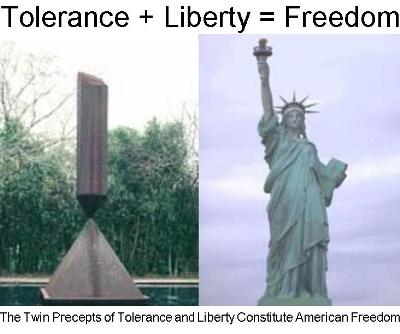
Do you agree that
• voluntary
immigration (that is "welcome" on Ellis Island) is a function of liberty (how many Africans arrived on Ellis Island?)
and that
• liberty (as signified by Liberty Island) is a function of tolerance (is personal freedom possible
in an intolerant society?) so that
• tolerance precedes even liberty as the dynamic component of “American”
freedom?
The precept of tolerance constitutes the basis for what unites us in freedom. It is a fundamental human
right and New York’s abiding seventeenth-century legacy to the nation.
Therefore, the Tolerance Park Foundation
is dedicated to transforming Governors Island, over time, into a "Tolerance Island," in the same way that Bedloe
Island, the location of the Statue of Liberty, was finally renamed in 1956. The Statue of Liberty was gifted by the people
of France in 1876 to commemorate the American Republic’s centennial and, after much objection and delay, inaugurated
finally in 1886.
It was on precisely September 11, 1609, that the East India Company ship Halve Maen (Half
Moon), captained by Henry Hudson, sailed through the narrows into New York harbor, thus covertly introducing to this continent
the dual notion of tolerance and liberty—inseparable as the successful foundation of American
heterogeneity and freedom—now the nation's ultimate and mutually dependent virtues as well
as New York's cultural heritage.
The TOLERANCE PARK has been planned since 1997, well before the unspeakable act
of intolerance and horrific destruction on 9/11/2001. The park with the 151 feet high TOLERANCE MONUMENT as centerpiece, was, and still is scheduled to be officially opened
in September 2009, thus marking the 400th anniversary of the arrival of the Half Moon in New York harbor.
Only immediate political action, dedicating 50 acres of Governors Island to the Tolerance Park, will assure that it
can open its doors on September 11, 2009, thus honoring also those who were lost and victimized in the most signal act
of intolerance on 9/11/2001.
|
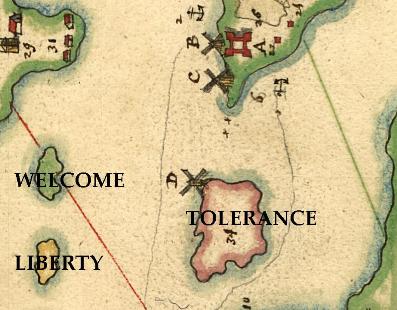
In America, the only existing historic symbol
of tolerance has yet to be officially recognized—Governors Island; the 1624 source of American pluralism and the birthplace
of New York State as well as New Jersey, Connecticut and Delaware.
The Tolerance Park could remind the world
that the dynamic notion of tolerance as a precursor to liberty-for-all remains an ongoing struggle and that only broad awareness
and conscious vigilance of religious, ethnic and racial tolerance will help safeguard and sustain “American” freedom,
because in an intolerant (disrespecting, discriminatory) society freedom-for-all is not possible.
When acknowledged
politically as the nation’s earliest fundamental cultural asset and the defining, active element in “American”
freedom, the island will preserve America’s oldest natural primary symbol—the lifeblood-of-liberty—for future
generations on the place of its birth, thus protecting the legacy of New York and the society that founded the colony among
the Original Thirteen.
Governors Island supersedes the other two island symbols in historical priority and national
meaning, in particular, because “Liberty” and “Welcome” derive from the dynamic conception of “Tolerance”—an
ethical force there planted first in North America by the settlers in 1624.
|
|
LOCUS
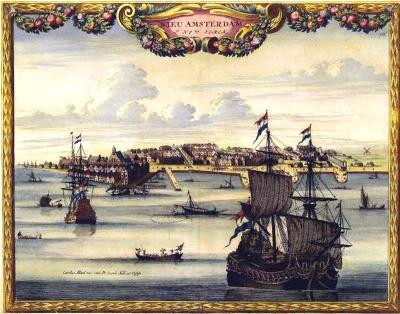
OF AMERICAN DIVERSITY: “They have as many sects of religion there as at Amsterdam” (The Virginian, William Byrd in 1682). The precept of religious tolerance as a juridical right and
cultural tradition—introduced in the Western Hemisphere on Governors Island in 1624—was recodified in New York
State's first Constitution of 1777. It was reintroduced to the Thirteen States' legislatures as one of several Congressional
Amendments in September 1787. New York State sanctioned
these Amendments on February 27, 1790, upon the signature of the "well-beloved George Clinton,
Esquire, Governor of our said State General." New Yorkers' unique juridical-political liberty of religious tolerance since the State's birth in 1624 became finally
a promise of religious freedom to all U.S. citizens in the First Amendment of the Original Thirteen States' Constitution
as ratified on December 15, 1791: “Congress shall make no law prohibiting the free exercise
of religion.” That promise of religious
liberty became only effective upon the ratification of the 14th Amendment in the Bill of Rights on July 9, 1868: "No State shall make or enforce any law which shall abridge the privileges or immunitives of citizens
of the United States."
|
The 1624 Governors
Island settlement became the foundation of a highly relevant and important piece of American history whose principles have
withstood the test of time and were indispensable in the further development of the United States. Its legacy is of profound meaning and significance because its concepts of religious and ethnic tolerance,
and civic and economic inclusiveness are the very ideals which form the bedrock of American political philosophy and culture.
To this very day those notions live in America’s cultural
history, its political institutions, and in its political and civic culture. That inheritance is also immensely pertinent to the future of our diverse nation as it is the "dynamic"
precept of tolerance that specifically distinguishes AMERICAN freedom from being a "generic" or
"static" concept. For history CLICK HERE
|

